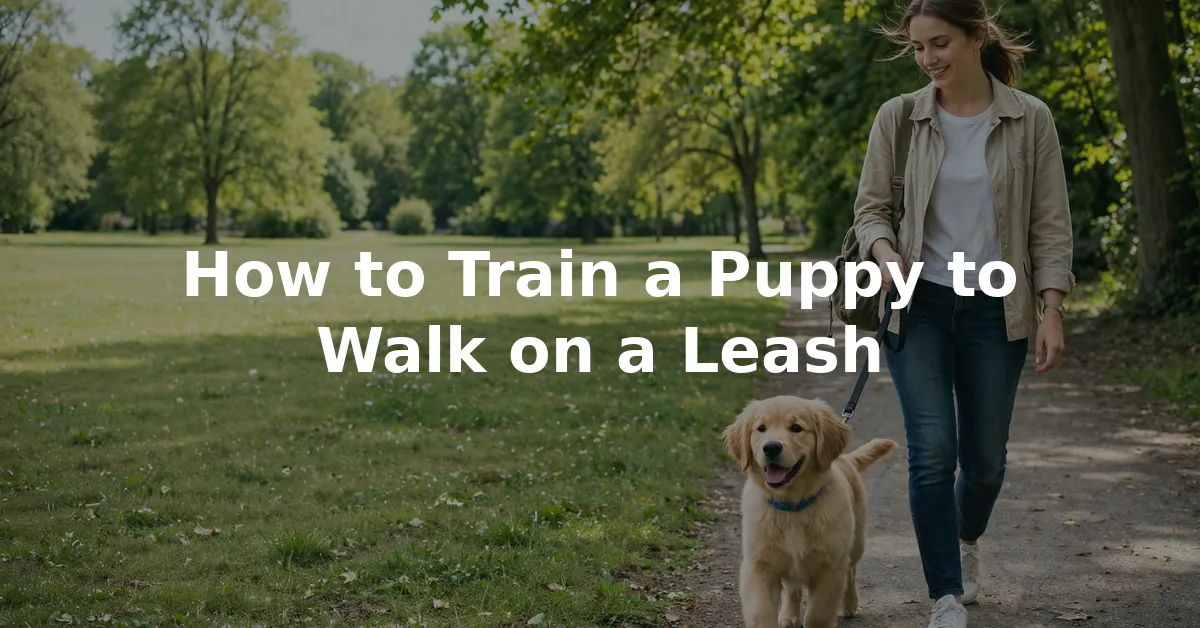
How to Train a Puppy to Walk on a Leash
Learning how to train a puppy to walk on a leash is easier than it looks — with short, positive sessions, most puppies get the basics in a few weeks.
Few things are more frustrating — or more fun — than a puppy’s first walks. One minute your puppy is trotting happily beside you, the next they are lunging at a leaf, sitting down in the middle of the sidewalk, or chewing the leash like it is a toy. That is completely normal. Puppies are not born knowing how to walk on a leash. They have to learn it, step by step.
The good news is that leash training is one of the easiest skills to teach if you start early and keep sessions short and positive.
This guide covers when to start, how to choose a leash, collar, and harness, indoor first steps, loose-leash basics, and how to handle the most common problems: pulling, leash biting, and freezing in fear. It also includes a simple 4-week practice plan and the mistakes that slow most owners down. If you have just brought your puppy home, read our How to Take Care of a New Puppy first-week checklist first — leash training works best when your puppy already has a routine and a vet check booked.
Table of Contents
When to start leash training
You can start the day your puppy comes home, usually at 8 weeks old. That does not mean long walks around the block. It means short, gentle introductions indoors: let your puppy sniff the leash, wear the collar for a few minutes at a time, and take a few steps with you across the living room.
Do not wait until your puppy is fully vaccinated to begin. The first lessons happen inside your home and in your yard, where the risk of disease is low.
The window between 8 and 16 weeks is the most important socialization period in a puppy’s life. Puppies gently exposed to new sights, sounds, and surfaces during this time grow into confident adult dogs.
Choosing the right leash, collar, and harness
The leash. Start with a standard flat leash, 4 to 6 feet long (about 1.2 to 1.8 meters), made of nylon or leather. A 6-foot leash gives your puppy room to sniff without giving them so much slack that they can build up speed and yank you. Avoid retractable leashes for training. They teach a puppy that pulling makes the leash longer — the exact opposite of what you want — and they give you less control if your puppy runs toward a road or another dog.
The collar. A lightweight flat collar with an ID tag is the simplest choice for most puppies. Make sure you can fit two fingers between the collar and your puppy’s neck: snug enough that it cannot slip over their ears, loose enough that it does not press on their throat. Avoid choke chains and prong collars for puppies. They work by causing pain, can damage a puppy’s developing neck, and damage trust — the last thing you want in a training relationship.
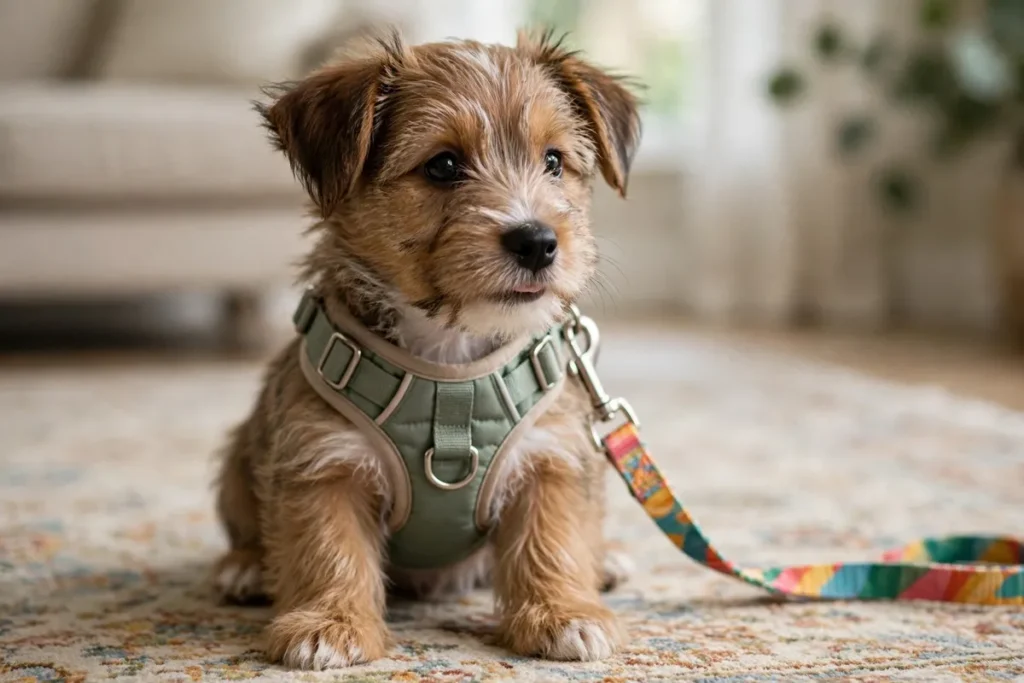
The harness. Many trainers prefer a harness for puppies, because it spreads pressure across the chest instead of the neck. A front-clip harness, where the leash attaches at the chest, is especially useful for pullers: when your puppy pulls forward, the harness gently turns them back toward you.
Step 1: Let your puppy get used to the collar and leash indoors
Before your puppy takes a single step on a leash, they need to feel comfortable wearing the gear. Rushing this step is the most common reason puppies hate walks.
Place the collar and leash on the floor and let your puppy sniff them, giving a treat for any interest. Then put the collar on for a few minutes during playtime or meals, so your puppy associates it with good things. Take it off before they get annoyed. Once the collar is comfortable, attach the leash and let it drag on the floor while your puppy walks around the house, under your supervision. After a few minutes, pick up the leash and follow your puppy around the house. Let them lead.
Step 2: Teach your puppy that the leash means good things
Once your puppy is comfortable with the gear, start short training sessions indoors. Keep each session to 5 minutes or less, and do 2 to 3 sessions a day.
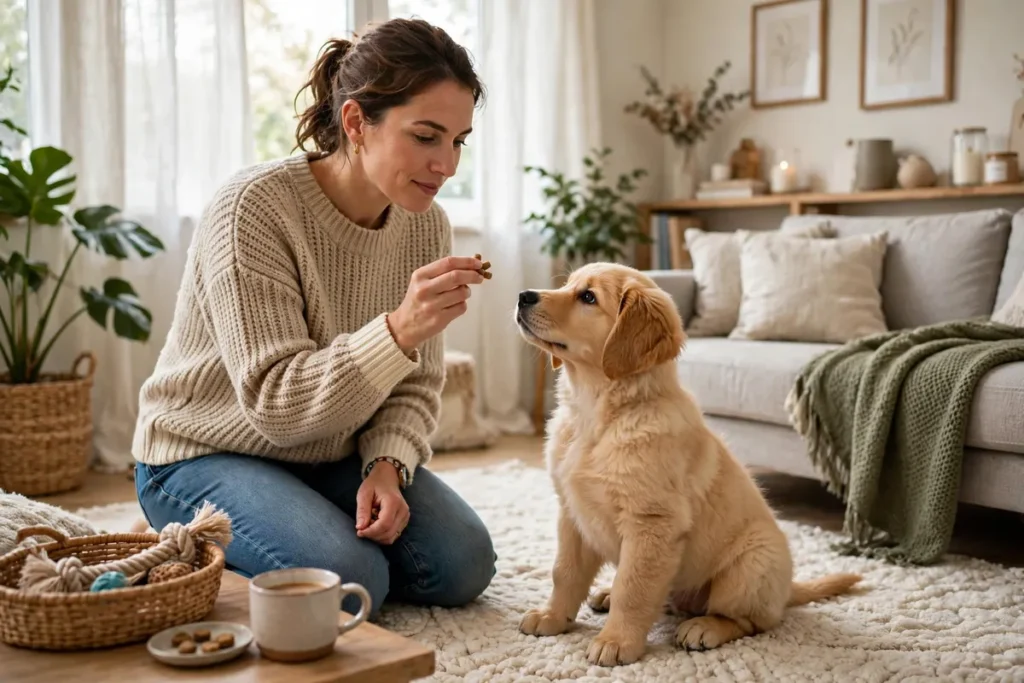
Stand in a quiet room with your puppy on the leash, holding a few small, soft treats. Take one step forward. If your puppy follows, say “yes” or “good” in a happy voice and give a treat at your side, near your left leg. Take another step. Repeat. You are teaching your puppy a simple idea: walking next to you is where the good stuff happens.
Step 3: Loose-leash basics — the “be a tree” method
The core of loose-leash walking is simple: a tight leash gets your puppy nowhere, and a loose leash gets them everywhere they want to go.
Start walking with your puppy on a loose leash. The moment the leash goes tight because your puppy pulls ahead, stop walking. Stand still like a tree. Do not pull back on the leash — just wait. Your puppy will probably look back at you or take a step back, and the leash will slacken. The instant it does, say “yes” and walk forward again, rewarding your puppy at your side.
A few tips to make this method work:
- Reward position, not just behavior. Give treats when your puppy is at your side, so they learn that the spot next to your leg is the best place to be.
- Use high-value treats outdoors. Kibble works in the kitchen, but outside there are smells, birds, and other dogs competing for attention. Small pieces of cooked chicken, cheese, or soft training treats are worth more than dry kibble.
- Turn, don’t tug. If your puppy pulls toward something, turn and walk in the opposite direction. Your puppy will follow, and you can reward them when they catch up.
Step 4: Moving from the living room to the yard to the street
Do not jump from indoor practice straight to a busy sidewalk. Puppies learn in layers, and each new environment is a fresh challenge. Move to the next stage only when your puppy walks politely at the current one.
Stage 1: Indoors. Your puppy walks beside you around the house with a loose leash, responding to your turns and stops. This usually takes a few days to a week.
Stage 2: The yard or garden. The same skills, with grass, smells, and a little more space. Keep sessions short and keep the treats coming.
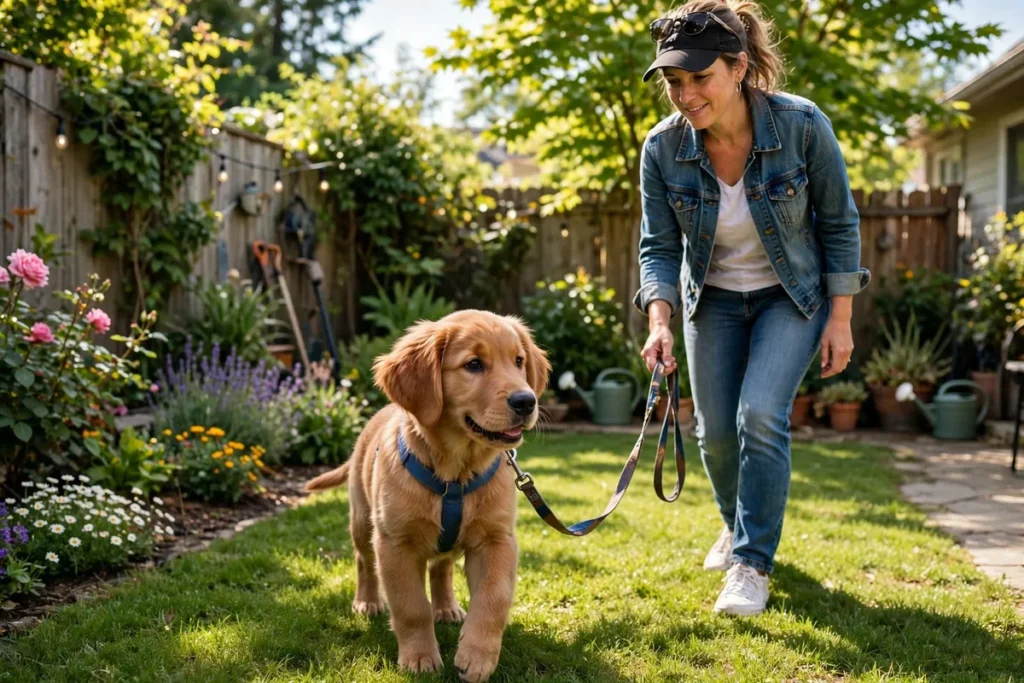
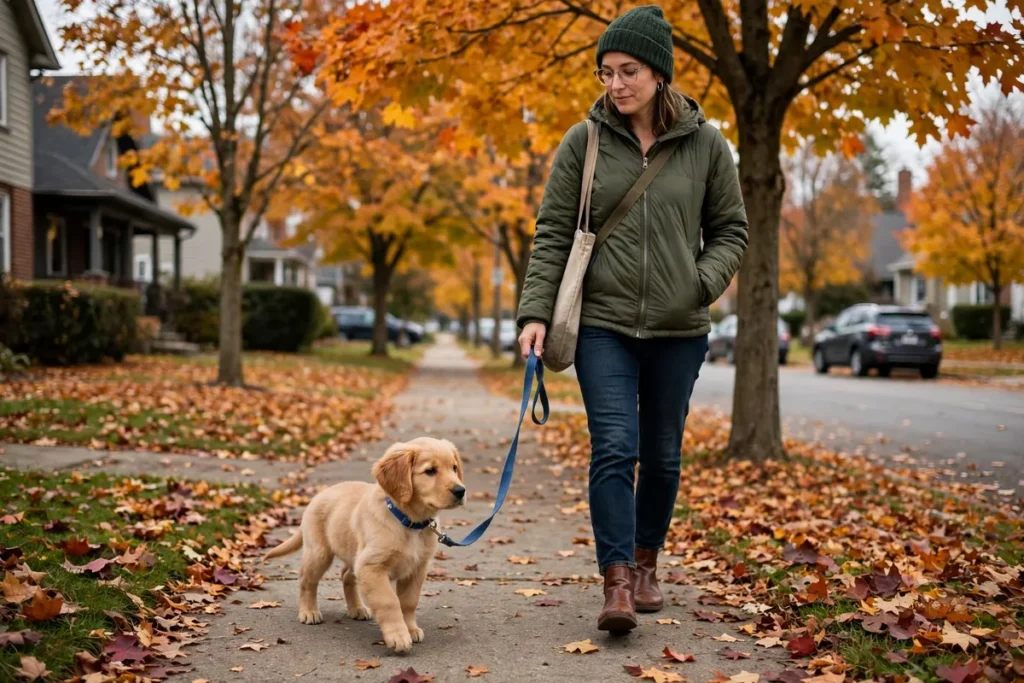
Stage 3: A quiet street or path. Choose a calm time of day and a quiet route. Keep the first outdoor walks to 5 to 10 minutes. Let your puppy sniff — sniffing is not misbehaving, it is how puppies read the world.
Stage 4: Busier places. Once your puppy is confident on quiet streets, gradually introduce more distractions: other dogs at a distance, people, traffic noise, and parks.
Dealing with pulling
Pulling is the number one leash problem, and it is almost always a training problem, not a stubbornness problem. Puppies pull because pulling works: they pull toward a smell, and they get to the smell. The “be a tree” method from Step 3 is your main tool. Here are a few extra strategies:
- Change direction often. If your puppy pulls ahead, turn and walk the other way. Your puppy has to pay attention to where you are going, instead of charging ahead.
- Stop and wait for eye contact. When the leash tightens, stop and wait until your puppy looks at you. Reward the eye contact, then walk on.
- Never pull back. Pulling back creates a tug-of-war and teaches your puppy that pressure on the leash is normal. Instead, stop, wait, or change direction.
Dealing with leash biting and chewing
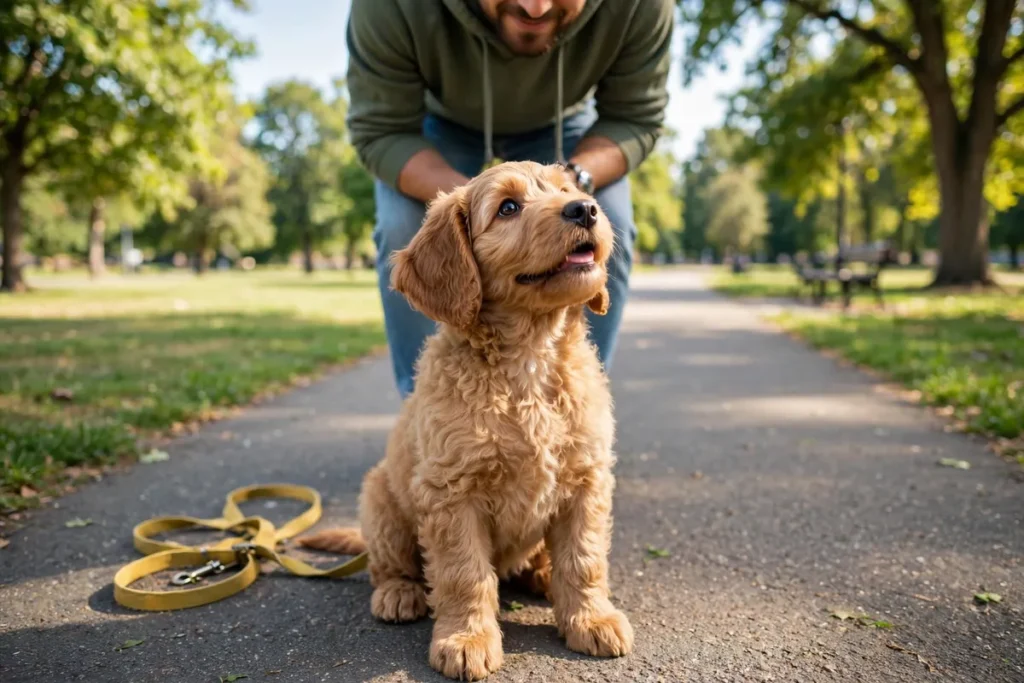
Many puppies bite and chew the leash. It dangles, it moves, and it is right at mouth level — from a puppy’s point of view, it is a toy you are holding for them. It is annoying, but it is not aggression.
The fix is to make the leash boring and give your puppy something better to do with their mouth. If your puppy grabs the leash, stop walking and stand still. Do not pull the leash out of their mouth — that turns it into a tug game. Wait for them to drop it, then reward them and walk on.
When your puppy stops, sits down, or freezes
A puppy that plants their feet and refuses to move is not being stubborn. They are usually tired, scared, or overwhelmed. Forcing them forward by dragging the leash will make the fear worse and can injure their neck.
If your puppy freezes, crouch down to their level and speak in a calm, happy voice. Offer a treat and wait. If they are tired, pick them up and carry them home — that is perfectly fine for a young puppy. If they are scared of something specific, like a loud truck or a barking dog, move further away and let them watch from a safe distance. Reward calm behavior.
Walking in busy places: other dogs, people, and traffic
Busy places are the final exam of leash training, and you should not rush to them. When you do start, use distance as your friend. A puppy that can stay calm 20 feet from another dog is learning.
Teach your puppy a simple rule: we do not greet every dog and every person we meet. Let your puppy greet people and friendly dogs sometimes, but only when they are calm and the leash is loose. If your puppy lunges or pulls toward a greeting, calmly turn and walk away. The greeting is the reward, and it only happens when the leash is loose.
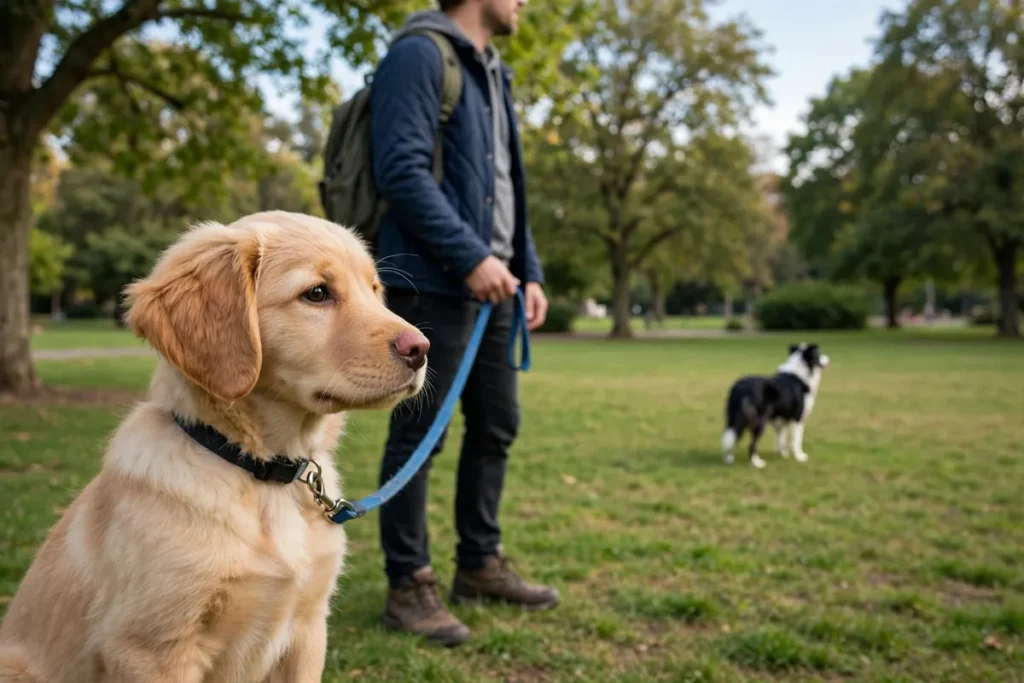
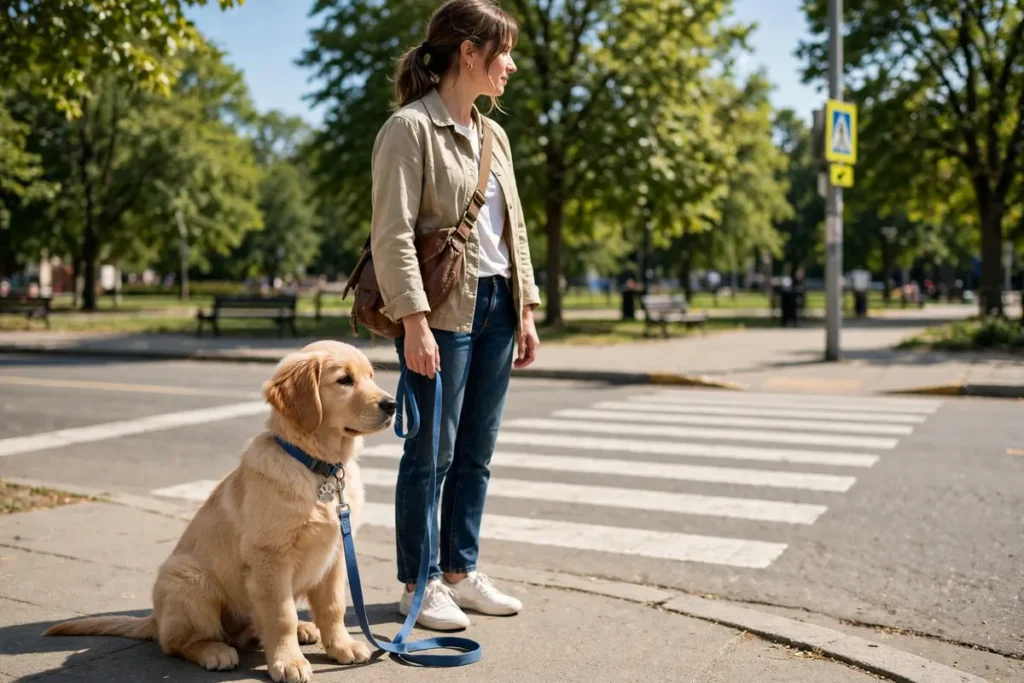
For traffic, keep your puppy on the side away from the road, and use sidewalks or paths whenever possible.
A simple 4-week daily practice plan
Consistency beats intensity. Two short sessions a day will teach your puppy more than one long session on the weekend.
Week 1: Indoors. Two 5-minute sessions a day. Collar and leash introduction, walking around the house, rewarding your puppy at your side.
Week 2: Yard and quiet street. Two 5 to 10-minute sessions a day. Practice the “be a tree” method in the yard, then on a quiet street. Introduce turns and stops.
Week 3: Longer walks, more distractions. Two 10 to 15-minute walks a day. Practice on different streets, near parks, and around mild distractions. Introduce sit-and-wait at curbs.
Week 4: Real walks. Two 15 to 20-minute walks a day, depending on your puppy’s age. Practice passing other dogs at a distance, walking past people, and handling busier streets.
Common mistakes to avoid
- Starting with long walks. A 30-minute walk is too much for a young puppy. Short and successful beats long and miserable.
- Using a retractable leash for training. It rewards pulling and gives you less control.
- Pulling back on the leash. It creates a tug-of-war and teaches your puppy that leash pressure is normal.
- Punishing your puppy for pulling. Yelling, yanking, or scolding will make them anxious, not obedient, and teaches them that walks are stressful.
- Inconsistent rules. If pulling works on Monday and not on Tuesday, your puppy will keep trying. Everyone in the household should use the same method.
- Forgetting treats. Training without rewards is just walking. Carry treats on every walk for the first few months — you can fade them out once the habit is solid.
Frequently asked questions
How long does it take to train a puppy to walk on a leash?
Most puppies learn the basics in 2 to 4 weeks of consistent daily practice, and walk politely most of the time within 2 to 3 months. Large breeds and very excitable puppies may take a little longer. For more puppy training guidance, see the American Kennel Club, and after practice, a comfortable place to rest matters — see our guide to the best dog beds for every budget.
What age should I start leash training my puppy?
Start at 8 weeks old, indoors, with short sessions. Your puppy does not need to be fully vaccinated to learn the basics inside your home and yard. Wait for your vet’s all-clear before walking in public places where unvaccinated dogs may have been. At home, a pet gate can keep your puppy in the room where you are training — see our guide to the best pet gate for dogs.
Should I use a collar or a harness for leash training?
Either can work, and many owners use both — a collar for the ID tag and a harness for the leash. A front-clip harness is often the best choice for puppies that pull, because it gives you more control without putting pressure on their neck.
Why does my puppy pull on the leash even though I stop every time?
Usually because the pulling is still being rewarded somewhere — maybe by other family members, maybe on walks where you give in because you are in a hurry, or maybe because the puppy gets to the exciting thing eventually, even after a delay.
The bottom line
Learning how to train a puppy to walk on a leash comes down to three things: start early, keep sessions short and positive, and be consistent. Choose a simple flat leash and a comfortable collar or front-clip harness, teach the basics indoors first, and use the “be a tree” method so your puppy learns that a loose leash is what keeps the walk going. Handle pulling, leash biting, and freezing with patience, not punishment. Follow the 4-week plan, and by the end of the month you should have a puppy that walks beside you happily — most of the time, anyway.
Disclaimer: This article is for general information only and is not a substitute for professional veterinary or behavioral advice.