KONG vs Nylabone: Best Chew Toys for Aggressive Chewers
If your dog destroys every toy within minutes, you have probably heard the same two names over and over: KONG and Nylabone. They are the two best-known chew toy brands in the world, and both make toys for dogs who chew hard — but they work in very different ways, and the wrong pick can mean a shredded toy, a bored dog, or worse, a cracked tooth.
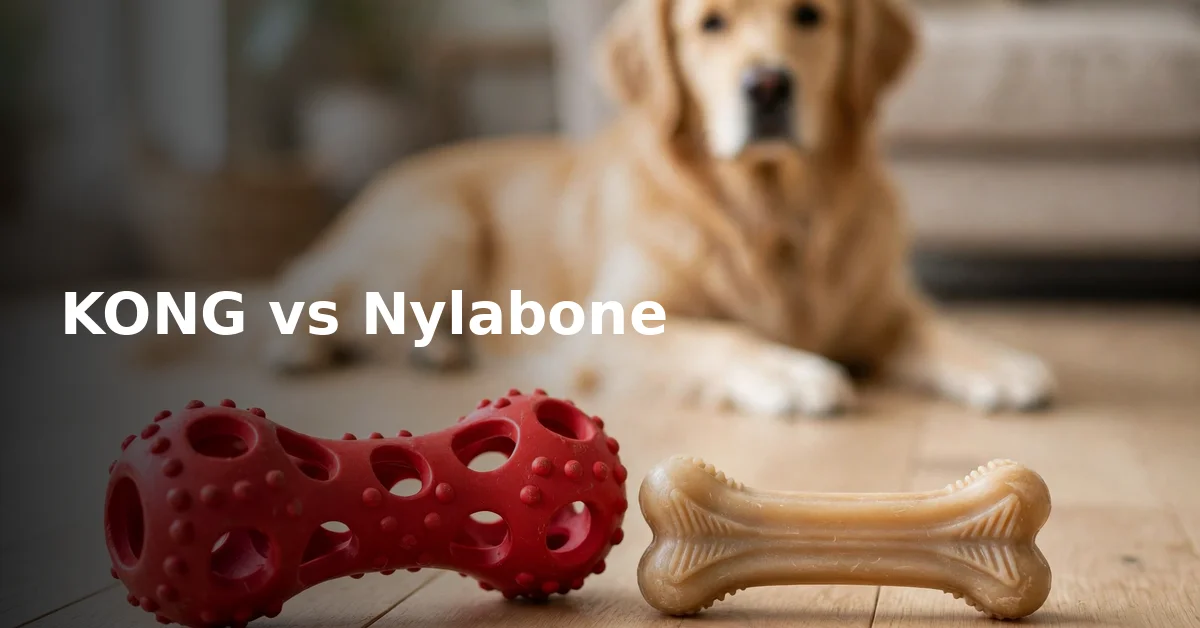
KONG vs Nylabone is not really a contest with one winner. It is a choice between two ideas: soft, stuffable rubber you fill with food, or hard, flavored nylon your dog gnaws on for hours. This guide compares them so you can pick the right one for your dog.
Prices change, so check the current price before buying.
KONG vs Nylabone at a Glance
| Feature | KONG | Nylabone |
|---|---|---|
| Material | Natural rubber, soft with give | Hard molded nylon |
| Best for | Stuffing, freezing, fetch, and licking | Long gnawing sessions |
| Durability | Very tough, but a determined chewer can tear it | Very hard, lasts a long time for most dogs |
| Tooth safety | Rubber gives under pressure, gentler on teeth | Hard nylon can crack teeth in strong chewers |
| Stuffable | Yes — fill with kibble, peanut butter, or treats | No, most are solid chews |
| Flavors | Plain rubber, food adds the flavor | Built-in flavors like bacon and chicken |
| Sizes | Puppy, Classic, Extreme, Senior, and more | Puppy, moderate, power chewer, and giant sizes |
| For aggressive chewers | KONG Extreme, the black rubber formula | Nylabone DuraChew and Power Chew lines |
| Cleaning | Rinse or dishwasher-safe | Rinse and scrub |
| Supervision | Always supervise, replace when torn | Always supervise, replace when worn down |
| Cost per toy | Mid-range, one toy lasts a long time | Usually lower per toy, but they wear down |
What Is a KONG?
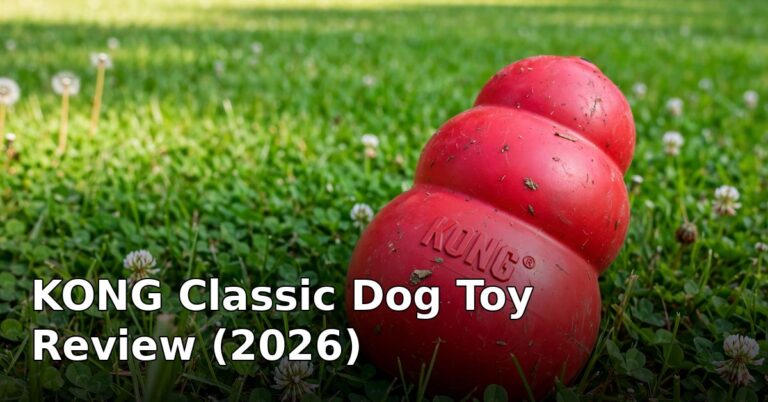
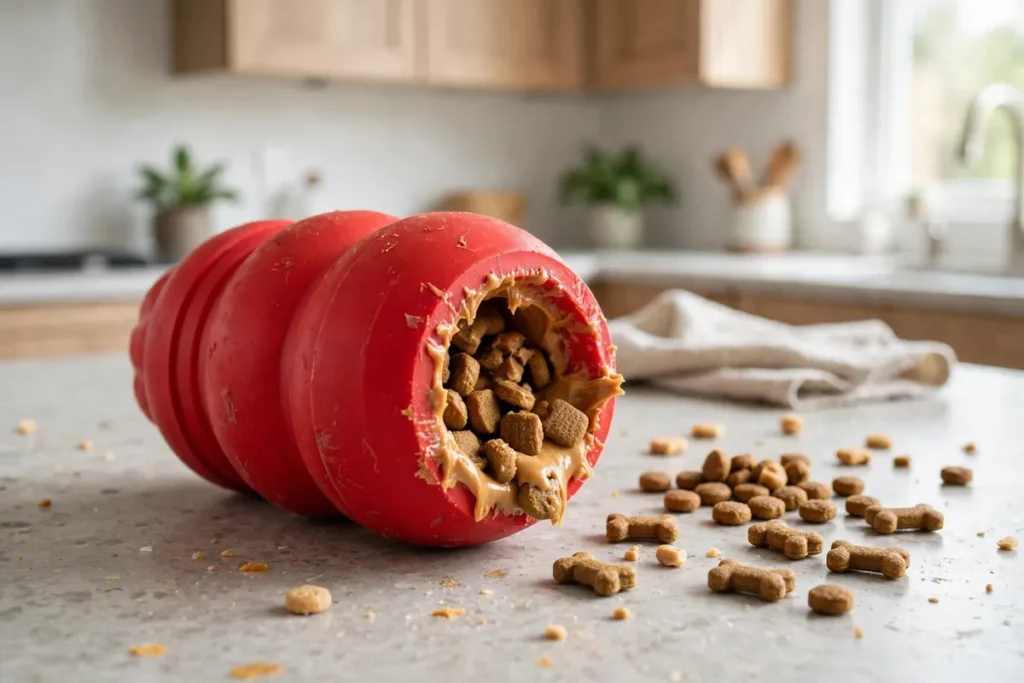
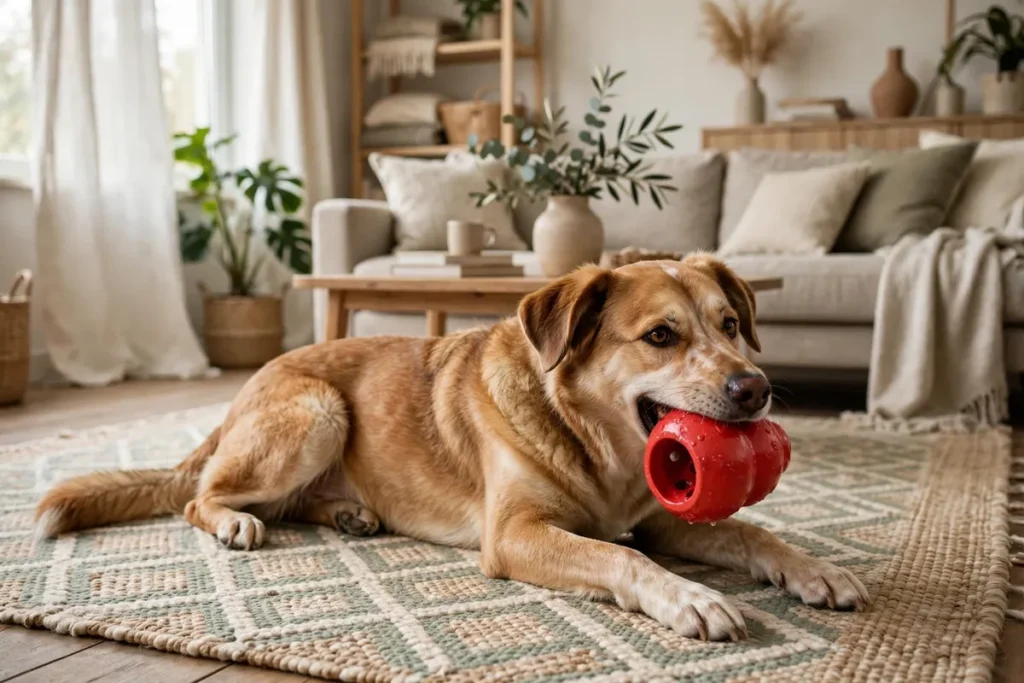
A KONG is a hollow rubber toy shaped a bit like a snowman with three stacked balls. The classic red KONG is made from natural rubber that flexes when your dog bites it, then springs back. The hollow middle is the whole point: you stuff it with kibble, smear peanut butter inside, or fill it with wet food and freeze it, and your dog has to work to get the food out.
The rubber has some give, which matters for teeth. A toy that bends a little under pressure is much less likely to crack a tooth than a rock-hard chew, which is why vets and trainers tend to recommend rubber toys first for strong chewers.
What Is a Nylabone?
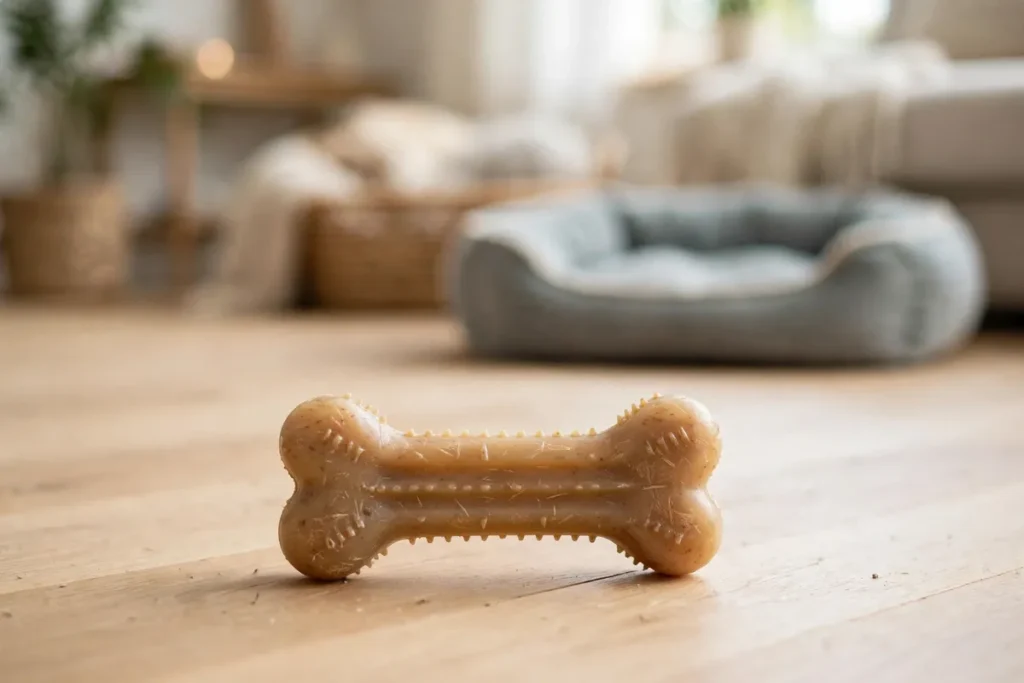
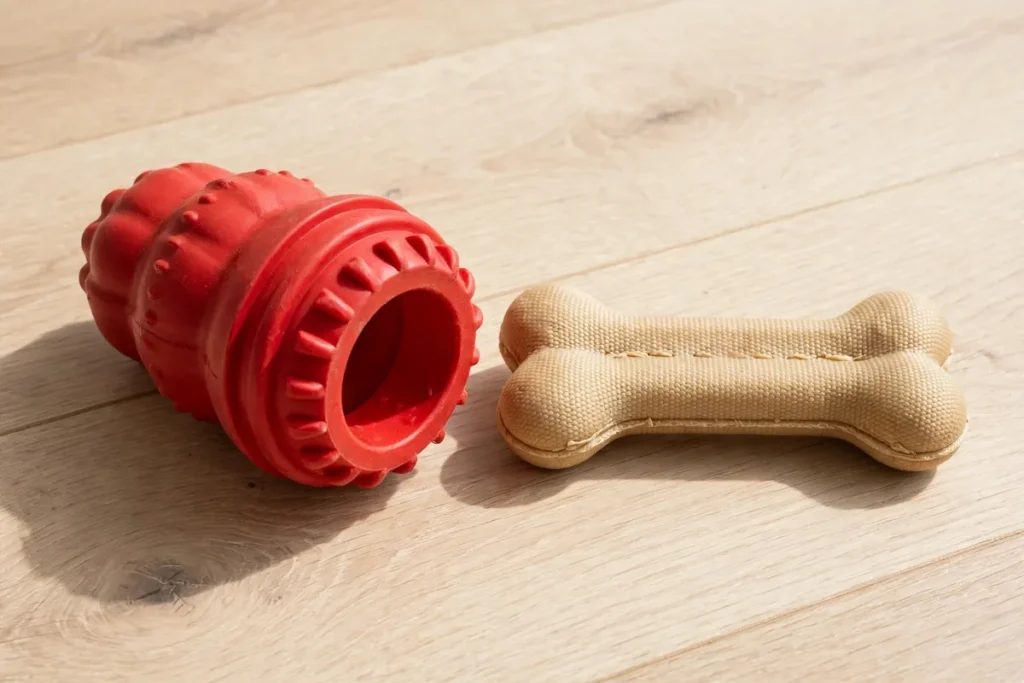
A Nylabone is a hard molded chew made from nylon, usually shaped like a bone, a ring, or a wishbone, and flavored all the way through. Your dog does not eat it like a treat. Instead, the dog gnaws on it for a long time, and tiny shavings wear off as the dog chews. The chewing itself is the reward, helped along by the flavor.
Nylabone makes several lines for different chewing styles. The DuraChew line is the classic hard nylon bone for moderate to strong chewers, the Power Chew line is the toughest version for dogs who destroy ordinary toys, and the Puppy Chew line uses a softer nylon for teething puppies. Nylabone also makes Healthy Edibles, which are fully edible chews — a different product from the durable nylon bones, and one your dog finishes in a single sitting.
The flavor is built in, so there is nothing to stuff and nothing to freeze. For a dog who just wants to gnaw for an hour, that simplicity is a real selling point.
Durability: Which One Lasts Longer?
For most dogs, a Nylabone DuraChew or Power Chew lasts longer than a KONG, simply because hard nylon is harder to destroy than rubber. A dog can gnaw on the same Nylabone for weeks, wearing it down slowly, while a determined chewer can tear chunks out of a rubber KONG in a single afternoon.
But durability depends on the dog. For the very strongest chewers, the KONG Extreme often wins, because its thick black rubber flexes instead of snapping, and there are no edges for a dog to bite through. A Nylabone, by contrast, can develop sharp edges as it wears, and a powerful jaw can break off a chunk.
Neither brand claims its toys are indestructible. Inspect them regularly and replace them when they wear thin or break.
Safety: Teeth, Swallowing, and Supervision
Safety is where the KONG vs Nylabone comparison gets serious, because the two materials carry different risks.
Hard nylon is the bigger dental risk. Veterinary dentists warn that chews that do not bend can fracture teeth, and the big upper premolar — the tooth dogs use most when chewing — is the one that usually breaks. VCA Animal Hospitals lists chewing on hard objects such as antlers, bones, or hard, non-bending chew toys among the causes of fractured teeth, and advises owners to throw out chews or toys that do not readily bend. A Nylabone is exactly that kind of hard, non-bending chew.
KONG rubber is gentler. It gives under pressure, so it is much less likely to crack a tooth. That does not make it risk-free: a dog who tears off a chunk of rubber and swallows it can still end up with a blockage, which is why you should always supervise and throw the toy away once it starts to break apart.
The ASPCA’s advice covers both brands the same way: match the chew to your dog’s size and chewing habits, watch your dog while they chew, and throw out durable chews before they wear thin. The ASPCA’s guide to destructive chewing also explains why dogs chew — boredom, anxiety, teething, or simply because chewing feels good.
A simple test helps with any chew: press your thumbnail into it. If you can dent it, it has enough give to be kinder to teeth. If it feels like stone, it is hard enough to break one.

Sizes: Getting the Fit Right
Both brands live or die on sizing, and both make it easy to get wrong.
A KONG that is too small is a swallowing risk, and a KONG that is too big is frustrating — your dog cannot get the food out, so they give up. KONG sizes run from extra small to extra large, roughly by weight, and for a power chewer KONG suggests sizing up, because a bigger toy has thicker rubber walls. A Nylabone that is too small is also a swallowing risk, and one that is too big is too hard to hold. Nylabone sizes run from petite and regular up to wolf and souper, matched to your dog’s weight and jaw strength. For both brands, the toy should be too big to fit entirely in your dog’s mouth — when in doubt, size up.
Cost: What You Pay Over Time
A single Nylabone usually costs less than a single KONG, and for a moderate chewer it lasts longer, so Nylabone often wins on cost per month. A KONG costs more up front, but one KONG can serve for months as a food puzzle, a fetch toy, and a chew toy in one.
The real cost is replacement — and the biggest cost of all is a cracked tooth. A veterinary dental repair is one of the most expensive bills a dog owner can face, so a cheaper toy that is also a harder toy is not always the bargain it looks like.
Which Is Better for Your Dog?
Choose KONG if: your dog likes food puzzles, you want a toy you can stuff and freeze, your dog has sensitive teeth, or you want one toy for chewing, fetching, and keeping a bored dog busy. The KONG Extreme is the pick for genuine power chewers.
Choose Nylabone if: your dog is a steady gnawer who likes to chew for a long time, you want a low-maintenance toy with no stuffing and no mess, or your dog is a moderate chewer who wears toys down slowly. The Power Chew line is the pick for stronger jaws.
Choose both if: your dog is a heavy chewer with plenty of energy. Many owners keep a KONG for mealtimes and quiet time, and a Nylabone for the long gnawing sessions in between. Rotating two or three toys also keeps them interesting, so your dog does not get bored and go back to chewing your shoes.
If you are still building your dog’s toy box, our roundup of the best dog toys for aggressive chewers covers more options beyond these two brands, our KONG Classic dog toy review looks at the original red KONG in detail, and our roundup of the best dog puzzle toys has more food-puzzle ideas for dogs who need a job to do.
How to Use Chew Toys Safely
Always supervise at first. Watch how your dog chews a new toy for the first few sessions: do they gnaw gently, or do they bite down hard and try to break off pieces? A dog who tries to snap a toy in half needs a different toy, or a bigger size.
Inspect the toy every day for cracks, tears, worn-thin spots, and sharp edges. A Nylabone with a sharp worn edge can cut gums, and a KONG with a torn chunk missing is ready for the bin. Throw out any toy that is cracked, chewed thin, or missing pieces.
Rotate toys, too. Keep two or three out and put the rest away, then swap them every few days — a toy your dog has not seen for a week is interesting again, and rotation means no single toy takes all the wear.
Never leave a heavy chewer alone with a new toy. Even the toughest chew toy can break, and a dog alone with a broken toy is a dog who might swallow the pieces. VCA’s guide to fractured teeth in dogs is a useful reminder of what is at stake: a cracked tooth is painful, it can get infected, and fixing it usually means a vet visit under anesthesia. And never give cooked bones, antlers, or hooves as an alternative — they are harder than nylon and far more likely to break teeth or splinter.

Frequently Asked Questions
Is KONG or Nylabone better for aggressive chewers?
For most aggressive chewers, the KONG Extreme is the safer first pick, because its rubber gives under pressure and is kinder to teeth. Nylabone Power Chew lasts longer for steady gnawers, but its hard nylon carries a higher risk of cracked teeth. Many owners use both.
Can Nylabone break my dog’s teeth?
Yes, it can. Hard nylon does not bend, and veterinary dentists list hard, non-bending chews among the common causes of fractured teeth in dogs. Use the thumbnail test — if you cannot dent the chew with your thumbnail, it is hard enough to break a tooth — and supervise your dog while they chew.
How often should I replace a chew toy?
Replace it the moment it is cracked, torn, worn thin, or missing pieces. For a heavy chewer that can mean every few weeks, for a gentle chewer every few months. Inspect it every day and never wait for it to break completely.
The Bottom Line
KONG vs Nylabone comes down to what your dog actually does with a toy. If your dog likes to work for food, lick, and carry a toy around, a KONG — ideally the KONG Extreme for a power chewer — is the better pick, and it is gentler on teeth. If your dog is a steady gnawer who wants to chew for an hour without any fuss, a Nylabone Power Chew will last longer and cost less per month, as long as you watch for wear and replace it before it gets sharp or thin. Whichever you choose, size it up, supervise the first few sessions, and throw it away the moment it starts to break down.