How to Crate Train a Puppy: A Step-by-Step Guide
Getting a new puppy is exciting — and a little chaotic. Your puppy chews the table legs, has accidents on the rug, and cries at 2 a.m. Crate training helps. Done the right way, a crate gives your puppy a safe, cozy den, speeds up housetraining, and keeps your puppy safe when you cannot watch them. Learning how to crate train a puppy is not about locking your dog in a box. It is about teaching them that the crate is a good place — a quiet den where they can rest and feel secure.
This guide covers what crate training is, how to choose the right crate, a step-by-step plan, a schedule by age, troubleshooting, and the mistakes to avoid. If your puppy just arrived, start with our first-week puppy checklist too.
What Is Crate Training, and Why Does It Work?
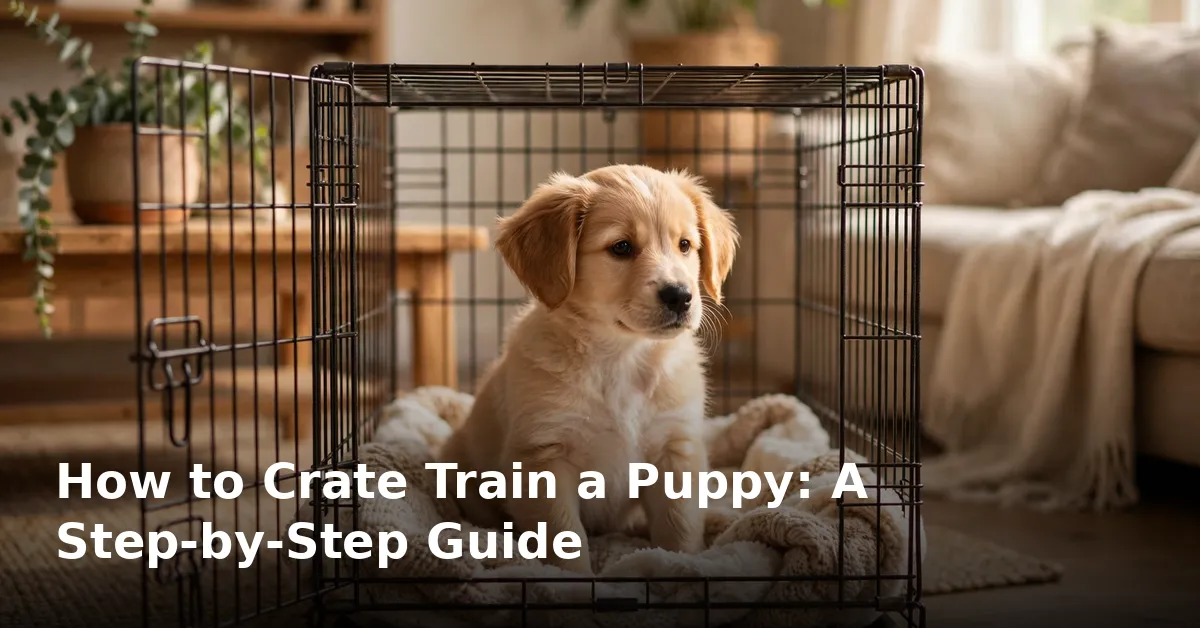
Crate training means teaching your puppy to see a crate as their den and to rest calmly inside it, with the door closed, for gradually longer periods. It works because dogs are den animals — their ancestors slept in small, sheltered spaces. A puppy given a comfortable crate will often choose to nap in it on their own.
It helps in four ways. First, housetraining: dogs avoid soiling where they sleep, so a puppy in a correctly sized crate will fuss to be let out rather than have an accident, which works hand in hand with a proper potty training plan. Second, safety: a loose puppy chews cables,
swallows socks, and climbs things they should not. Third, it gives your puppy a retreat when tired or overwhelmed. Fourth, it prepares your dog for vet visits, travel, and boarding. It is not a way to lock a puppy away for hours. A crate is for short, supervised rest — not a substitute for exercise, play, and company. Puppies left crated most of the day become anxious and harder to housetrain. The goal is a puppy who loves their crate and chooses to use it.
Choosing the Right Crate
Get this part right before your puppy arrives, because the wrong size or type makes training harder.
Get the Size Right
A crate should be just big enough for your puppy to stand up without crouching, turn around comfortably, and lie down stretched out. That is all. If the crate is too big, your puppy will sleep in one corner and use the other corner as a toilet, which defeats the whole point of crate training for housetraining.
Puppies grow fast, so buy the crate your puppy will need as an adult and use a divider panel to make the space smaller while they are young. Many wire crates come with a divider included. Move the divider back as your puppy grows. If you are not sure what size your puppy will be as an adult, ask your vet or the breeder for an estimate.
Wire, Plastic, or Soft-Sided?
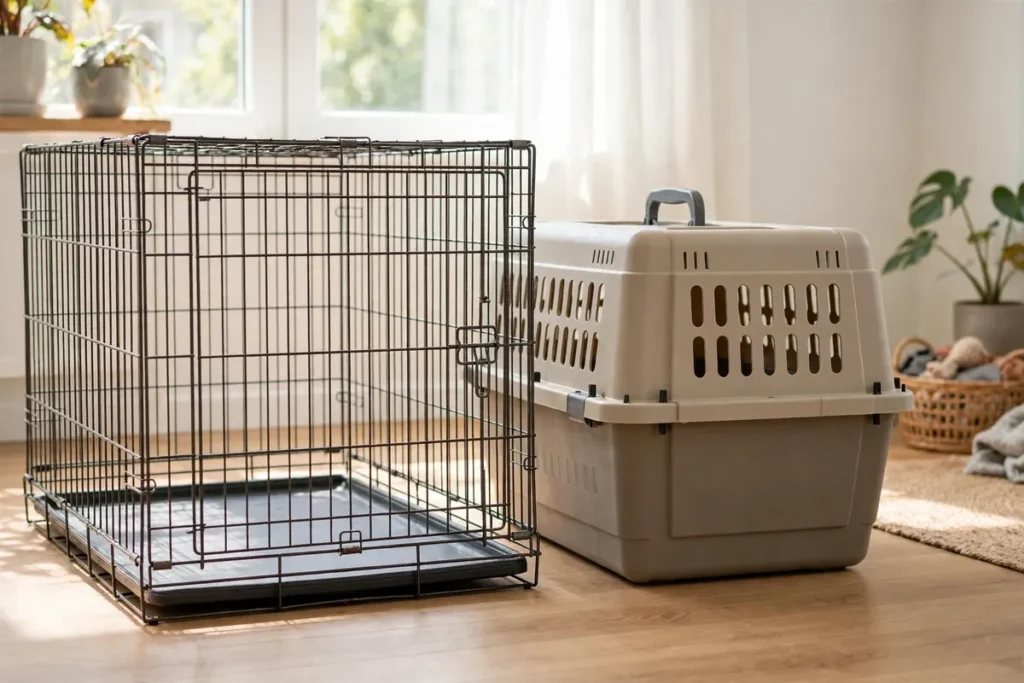
Wire crates are the most popular choice for home use. They fold flat, offer excellent airflow and visibility, and usually include a divider and a removable tray for easy cleaning. Some puppies feel exposed in a wire crate; a light blanket draped over the top and sides makes it feel more den-like.
Plastic or hard-sided crates are enclosed, kennel-style crates often used for air travel. They feel cozier, which suits nervous puppies, and they are sturdy and easy to clean. The downside is less airflow and visibility, and they do not fold down.
Soft-sided crates are lightweight fabric crates that fold down small, handy for travel and car trips. The downside is that a determined puppy can chew through fabric, so use one only once your puppy is already crate-trained and past the heavy chewing stage. For most new puppy owners, a wire crate with a divider is the best starting point.
Where to Put the Crate, and What Goes Inside
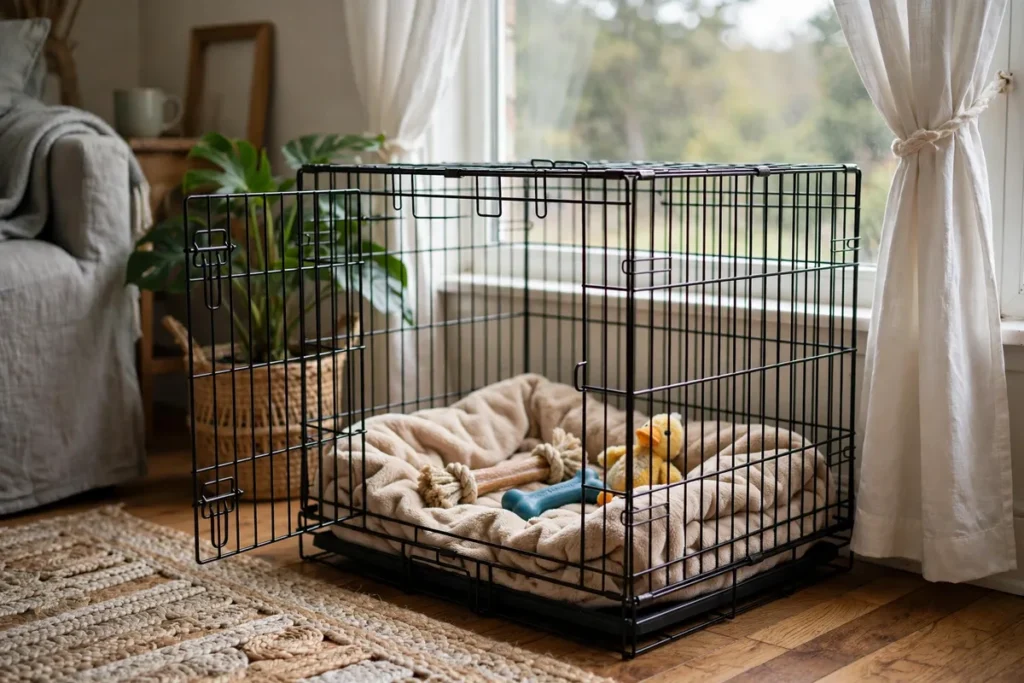
Put the crate where your puppy can be part of the family — a corner of the living room or kitchen. A puppy crated alone in a faraway room will feel isolated and cry. For the first week or two, keep the crate in your bedroom at night. Your puppy has just left their mother and littermates, and having you nearby helps them settle. You will also hear them when they need a nighttime toilet break. Avoid direct sunlight, radiators, and draughty hallways.
Keep the inside simple: a washable bed or folded blanket, and one or two safe chew toys. Avoid anything with small parts or stuffing that can be swallowed. Take your puppy’s collar off before crating them — collars and tags can catch on wire bars and become a choking hazard.
Before You Start
Gather a pouch of small, soft, high-value treats, cut into pea-sized pieces, and a stuffed chew toy filled with a little puppy-safe food and frozen. Pick one short cue word — “crate,” “kennel,” or “bed” — and use the same word every time in a cheerful tone. Agree the rules with everyone in the household first: the crate is never a punishment, nobody forces the puppy inside, and nobody lets the puppy out while they are barking or whining. Most puppies settle into a routine within one to two weeks; nervous puppies may need three or four. That is normal.
How to Crate Train a Puppy: The Step-by-Step Plan
Learning how to crate train a puppy works best in small, gradual steps. Rushing it — shutting the door on day one and leaving for hours — is the single most common reason it fails. Follow these steps in order, and only move on when your puppy is comfortable with the step before.
Step 1: Introduce the Crate (Day 1)
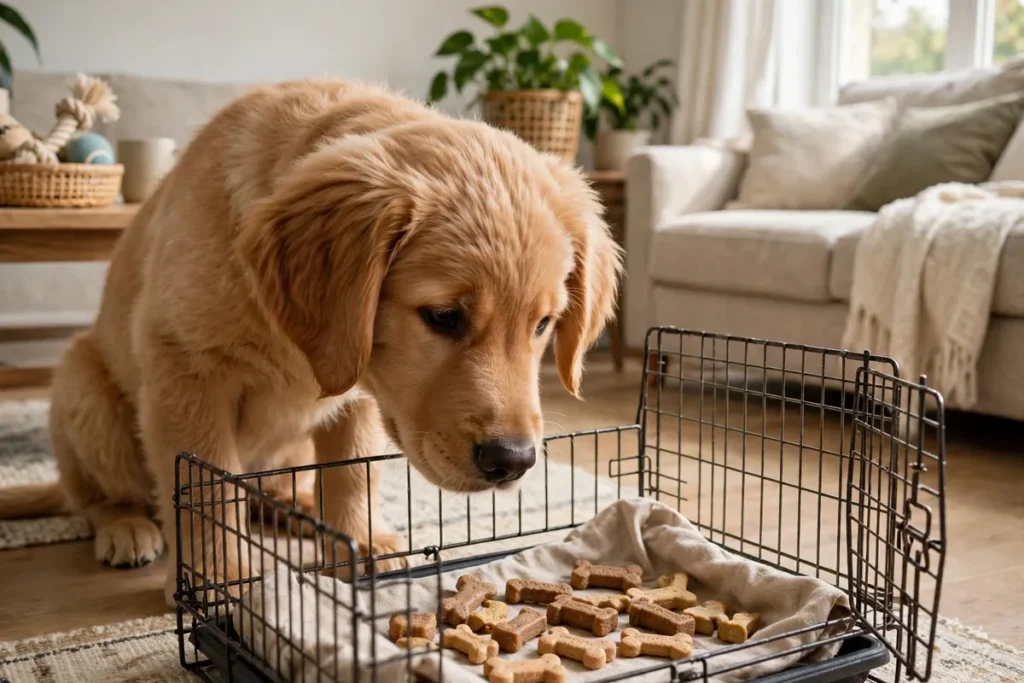
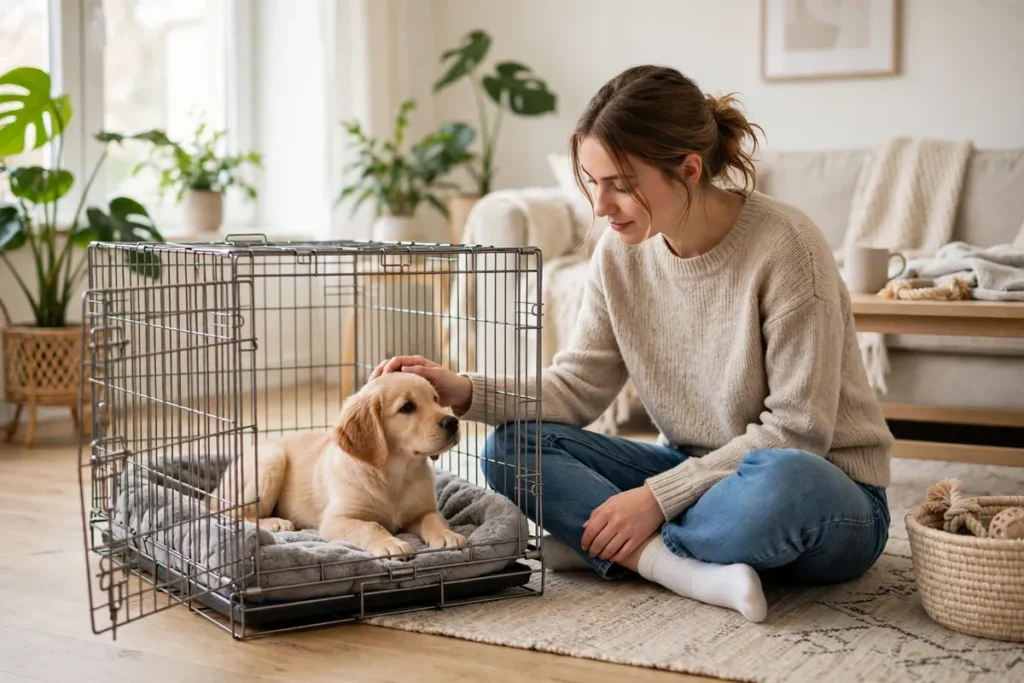
Put the crate in its spot with the door open and secured so it cannot swing shut. Place a few treats just outside the entrance, a few just inside, and a couple right at the back. Let your puppy explore in their own time. Do not push, carry, or lure them in and shut the door — the first experience must be voluntary. Most puppies will sniff around, grab a treat, and back out. That is fine.
Repeat a few times through the day: toss a treat inside, let your puppy walk in to get it, and let them walk straight out again. Keep these sessions to five minutes at a time. If your puppy will not go in at all, feed them near the crate and put a worn T-shirt of yours inside so it smells like you. Never drag your puppy toward the crate — that creates fear, and fear is very hard to undo.
Step 2: Feed Meals in the Crate
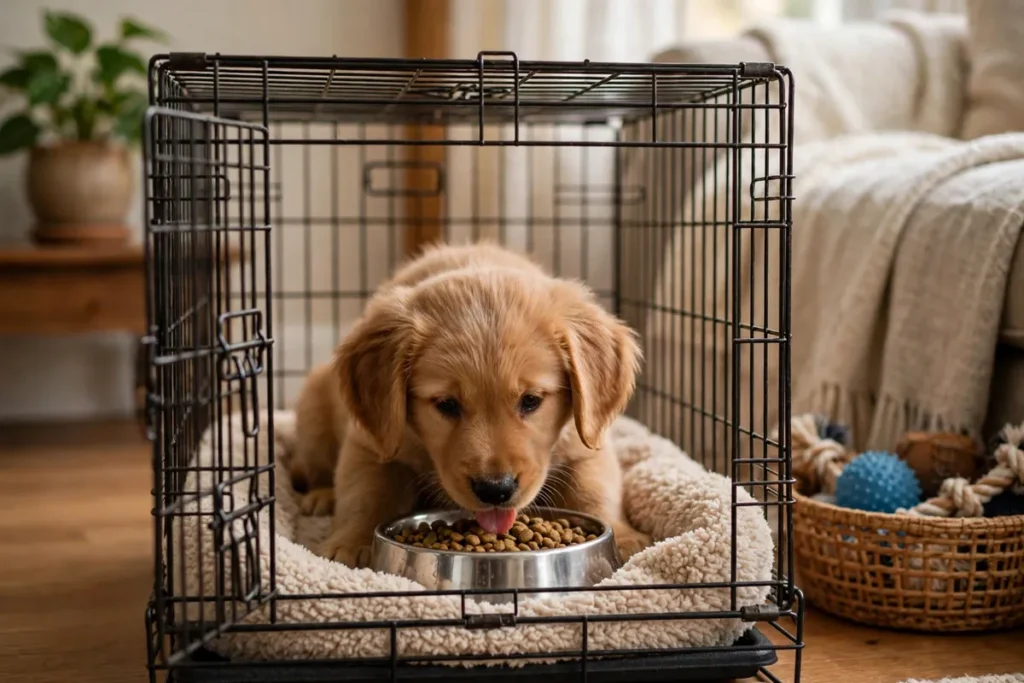
Once your puppy is happily walking in and out, start feeding meals inside. Put the food bowl just inside the door for the first meal, then a little further back with each meal, until the bowl is at the back of the crate. Your puppy will start to look forward to going in because the crate is where the food is. When your puppy is eating comfortably at the back, try closing the door while they eat, and open it as soon as they finish. Over the next few meals, leave the door closed a little longer after eating — a minute, then five, then ten — while you stay nearby. If your puppy whines, you moved too fast: open the door, and next time keep it shorter.
Step 3: Short Closed-Door Sessions
Now close the door for short periods outside of mealtimes. Ask your puppy to go in with your cue word and reward them the moment they step inside. Close the door, sit nearby, and give them a stuffed chew toy. Stay in the room for a few minutes, then open the door calmly. Do not make a big fuss about opening the door; a calm release teaches your puppy that coming out is no more exciting than going in. Extend these sessions gradually — five, ten, twenty, then thirty minutes — always returning before your puppy gets upset. If your puppy starts whining, wait for a brief pause in the noise before opening the door. Opening the door while they are whining teaches them that whining opens doors. If they are truly distressed, panting heavily, or trying to escape, open the door and go back a step.
Step 4: Leaving the Room
When your puppy is comfortable with the door closed for 20 to 30 minutes while you are in the room, start leaving the room. Give them a stuffed chew toy, close the crate door, and step out for just a minute or two. Come back quietly, before your puppy has a chance to get upset, and open the door calmly. Build up gradually — two, five, ten minutes, then half an hour — varying the time so your puppy cannot predict your return. A tired puppy settles far more easily than a wide-awake one, so give your puppy a short walk and a play session before longer crate sessions. A walk on the leash before crate time is a good habit to build early — if you have not started yet, see our guide on how to train a puppy to walk on a leash. A puppy that has burned off energy, had a toilet break, and has a chew toy will usually settle within a few minutes.
Step 5: Overnight Crate Training
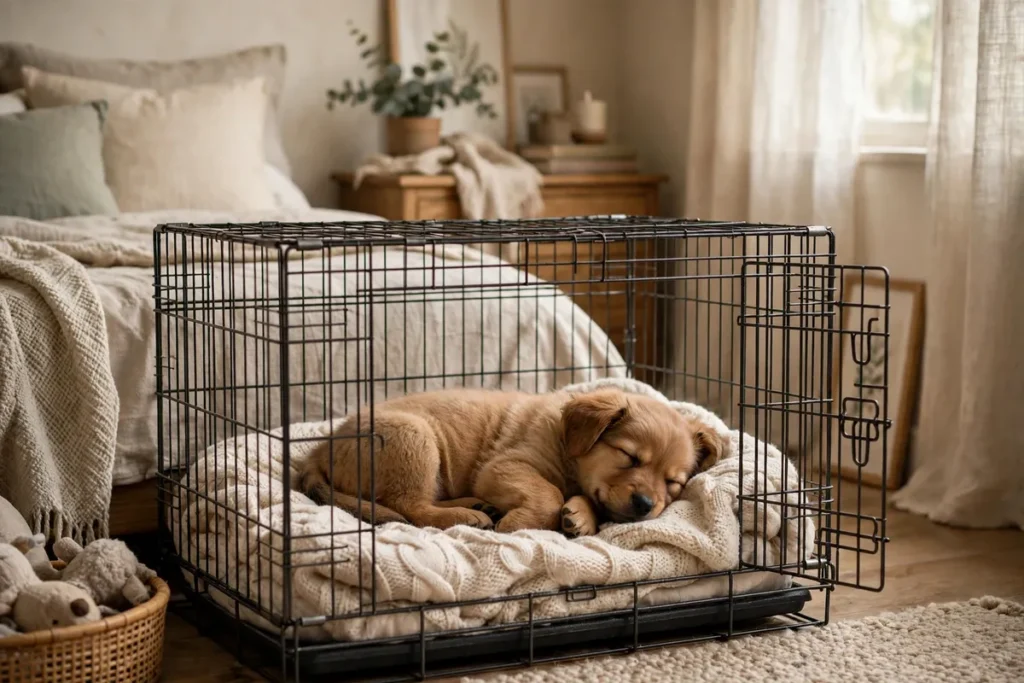
Nighttime is usually the hardest part. Give your puppy their last meal a few hours before bed, take away water an hour or so before bedtime, and exercise them in the evening so they are tired. Take them outside for a final toilet break right before bed. Put the crate in your bedroom for the first week or two, close to your bed where your puppy can hear and smell you. Expect one or two toilet breaks during the night for the first few weeks. When they wake and fuss, take them straight outside on a leash, let them relieve themselves, and put them straight back in with no play, no fuss, and no food. Keep the lights low and your voice calm. Boring nights teach your puppy that nighttime is for sleeping. Do not let your puppy sleep in your bed “just for tonight” — one night teaches them that crying gets them into bed, and you will have to start again.
Your First Week at a Glance
Day 1: crate door open, treats in and around it, puppy explores freely. Day 2: meals move into the crate; first very short closed-door moments during meals. Day 3: closed-door sessions of five to ten minutes while you stay in the room. Day 4: sessions stretch to twenty or thirty minutes; you step out briefly. Day 5: longer rest periods in the crate during the day. Days 6 and 7: your puppy goes in on cue, settles with a chew toy, and sleeps most of the night with one toilet break. Some puppies will be faster, some slower — both are normal.
How Long Can a Puppy Stay in a Crate? A Schedule by Age
A widely used rule of thumb is that a puppy can hold their bladder for roughly one hour for every month of age — a two-month-old puppy about two hours, a four-month-old about four hours. Treat that as a rough maximum, not a target. Use this table as a guide for the longest single stretch your puppy should spend in the crate during the day. At night, puppies can manage a little longer because they are asleep, but young puppies will still need a toilet break in the middle of the night.
| Puppy age | Longest daytime crate stretch | Notes |
|---|---|---|
| 8–10 weeks | 30–60 minutes | Needs a toilet break very often; nights need 1–2 breaks |
| 11–14 weeks | 1–2 hours | Bladder control improving; still needs a midday break |
| 15–20 weeks | 2–3 hours | Can manage a morning or afternoon in the crate with breaks |
| 5–6 months | 3–4 hours | Most puppies can hold it through a work morning with a midday break |
| 6+ months | 4–5 hours | Longer stretches become possible, but a full workday alone is still too much |
No puppy under six months should be crated for more than three or four hours at a stretch during the day, and no dog should spend most of the day in a crate. If you work full-time, arrange a midday visit from a family member, friend, or dog walker for a toilet break, exercise, and company. An adult dog can manage six to eight hours overnight, but even adults should not be crated for eight hours during the day on a regular basis.
A sample day for a twelve-week-old puppy: 7:00 a.m. outside for a toilet break and breakfast, then play and a short walk; 9:00 a.m. crate rest for an hour or two; 11:00 a.m. outside, play, and lunch in the crate; 1:00 p.m. another short crate rest; 3:00 p.m. outside, training, and play; 5:00 p.m. dinner; 7:00 p.m. walk and family time; 10:00 p.m. final toilet break and bed, with one nighttime break around 2:00 or 3:00 a.m. The pattern matters more than the clock: toilet, eat, play, rest in the crate, and repeat.
Troubleshooting Common Crate Training Problems
My Puppy Whines in the Crate
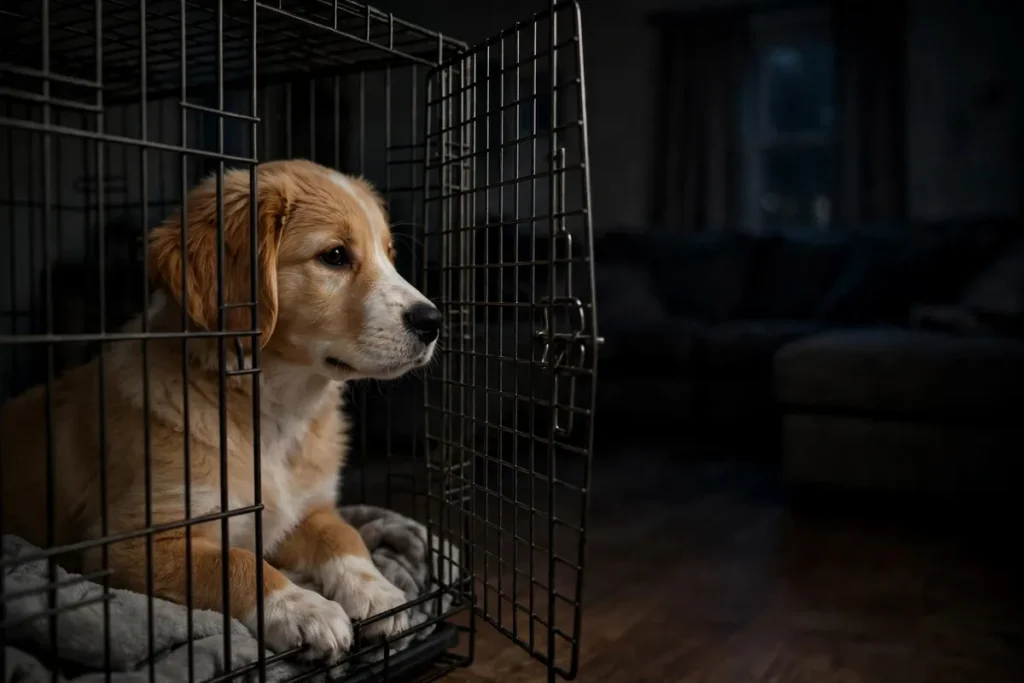
First, rule out the basics: does your puppy need the toilet, are they hungry or thirsty, too hot or too cold, or overtired? If all their needs are met and they are whining for attention, do not let them out while they are whining. Wait for a pause — even a few seconds of quiet — and then open the door calmly. If you open the door during the whining, your puppy learns that whining works, and it will get louder next time. Most attention whining fades within a few days.
My Puppy Barks in the Crate
Never shout at a barking puppy — shouting sounds like barking to a dog, and it will bark more. Check the crate is not the problem: is it too small, too hot, or in a noisy spot? Is your puppy getting enough exercise during the day? A puppy crated for hours with no walk and no play will bark out of frustration and boredom. If the barking is attention-seeking, use the same rule as whining: wait for quiet, then release. Covering the crate with a light blanket sometimes helps, because it blocks out visual stimulation.
My Puppy Has Accidents in the Crate
Accidents usually mean something in the setup needs adjusting. The most common cause is a crate that is too big — if your puppy has room to sleep in one end and toilet in the other, they will do exactly that, so move the divider forward. The second most common cause is waiting too long between toilet breaks — go back to the age table and shorten the stretches. Never punish a puppy after an accident; they cannot connect your anger with something they did minutes ago. Clean up quietly with an enzymatic cleaner, and adjust the schedule. If accidents keep happening despite a correctly sized crate and a good schedule, talk to your vet — frequent accidents can be a sign of a urinary tract infection.
My Puppy Has Separation Anxiety
Some puppies do not just protest — they panic. Signs include drooling, heavy panting, howling, frantic scratching at the crate door, and attempts to escape that can injure the puppy. Crate training alone will not solve this, and forcing the issue can make it worse. Slow down: go back to very short absences and build up in tiny increments, leaving for a few seconds and returning many times a day so your puppy learns that leaving always leads to returning. Keep arrivals and departures calm and low-key. If the anxiety is severe, ask your veterinarian for help — some puppies need a behavior modification plan, and in some cases medication, to learn to cope with being alone.
What NOT to Do: Crate Training Mistakes to Avoid
Never use the crate as punishment — the moment you send your puppy there because you are angry, the crate becomes a scary place. Never force your puppy inside; if they will not go in, the training has moved too fast. Do not leave your puppy crated for too long, and do not crate them with a collar on — collars can catch on crate bars and become a choking hazard. Do not ignore a distressed puppy: a puppy panting heavily, drooling, or howling is panicking, not being naughty. Let them out, calm them down, and go back to shorter sessions. Do not let children tease your puppy in the crate, and do not skip exercise before crate time — a puppy full of energy will not settle.
Frequently Asked Questions
How long does it take to crate train a puppy?
Most puppies learn to go in happily within a few days and settle into a routine within one to two weeks. Full reliability usually takes three to four weeks. Confident puppies can be faster; nervous or rescue puppies slower. Consistency matters most: short, positive sessions every day beat occasional long ones.
Should the crate be in my bedroom?
For the first week or two, yes. A new puppy that has just left their mother and littermates is frightened of being alone, and sleeping near you helps them settle. It also means you will hear them when they need a nighttime toilet break. Once your puppy sleeps through the night, you can gradually move the crate to its permanent spot.
Is it cruel to crate a puppy?
No — when done properly, it is not cruel. Dogs are den animals, and most crate-trained dogs choose to nap in their crate with the door open. What is cruel is misuse: leaving a puppy crated most of the day, using the crate as punishment, or ignoring a panicking puppy.
What if my puppy cries all night in the crate?
Check the basics first: has your puppy had a toilet break, are they warm enough, and is the crate close to you? Young puppies often need a nighttime toilet break for the first few weeks. Take them out calmly on a leash, let them relieve themselves, and put them straight back in with no play and no fuss. If their needs are met and they are crying for company, hold the line — most puppies settle within a few nights. Panicked crying is different; slow the training down and ask your vet for advice.
Bottom Line
Choose a crate that fits, introduce it slowly with treats and meals, build up closed-door time in small steps, and keep to a sensible schedule based on your puppy’s age. Expect some whining, some accidents, and a few noisy nights — that is normal, and it passes. A puppy that loves their crate is easier to housetrain, safer when you cannot watch them, and calmer at the vet, in the car, and in new situations.
Disclaimer: This article is general information, not a substitute for veterinary advice. If your puppy shows signs of severe anxiety, refuses food or water, has frequent accidents despite a good routine, or seems unwell, contact your veterinarian. Always supervise your puppy with chew toys, remove the collar before crating, and choose the crate size for your puppy’s weight and breed.